By the UppearNow Team | Reviewed by Kenny Hart, Sr SEO Consultant | Last updated: October 2026
Speed to lead is the time between a potential customer reaching out (a call, a form, a chat or an email) and your business replying in a useful way. The shorter that time, the more of those people become customers. Aim for under 5 minutes, and use automation to get the first reply out within 60 seconds.
The most repeated speed-to-lead statistic on the internet has no source. “78% of customers buy from the first company that responds” appears in countless sales decks, yet nobody has traced it back to a study. The real data tells a similar story, but it’s newer, more specific, and more useful for working out what slow replies cost your business.
Start with your own numbers. The calculator below takes about a minute.
You’re likely losing about
a year
a month, or roughly customers who went elsewhere.
a year of that is realistically recoverable with instant follow-up: missed-call text-back, instant replies to web leads and after-hours answering.
Get your plan to win these leads back
We’ll email you a one-page plan for , with your numbers and the 3 fixes that recover the most revenue.
Want this fixed for you?
Book a free growth reviewHow we calculate this
- Missed calls: half of unanswered callers are counted as lost. CallRail reports up to 85% of people whose calls go unanswered won’t call back, so 50% keeps the estimate conservative.
- Slow replies: compared with replying within 5 minutes, we count 20% fewer customers when you reply within an hour, 40% fewer same day and 60% fewer next day or later. Published studies show bigger drops, so these figures stay on the cautious side.
- Recoverable: we assume instant text-back wins back half of the missed-call losses and instant replies win back 80% of the slow-reply losses.
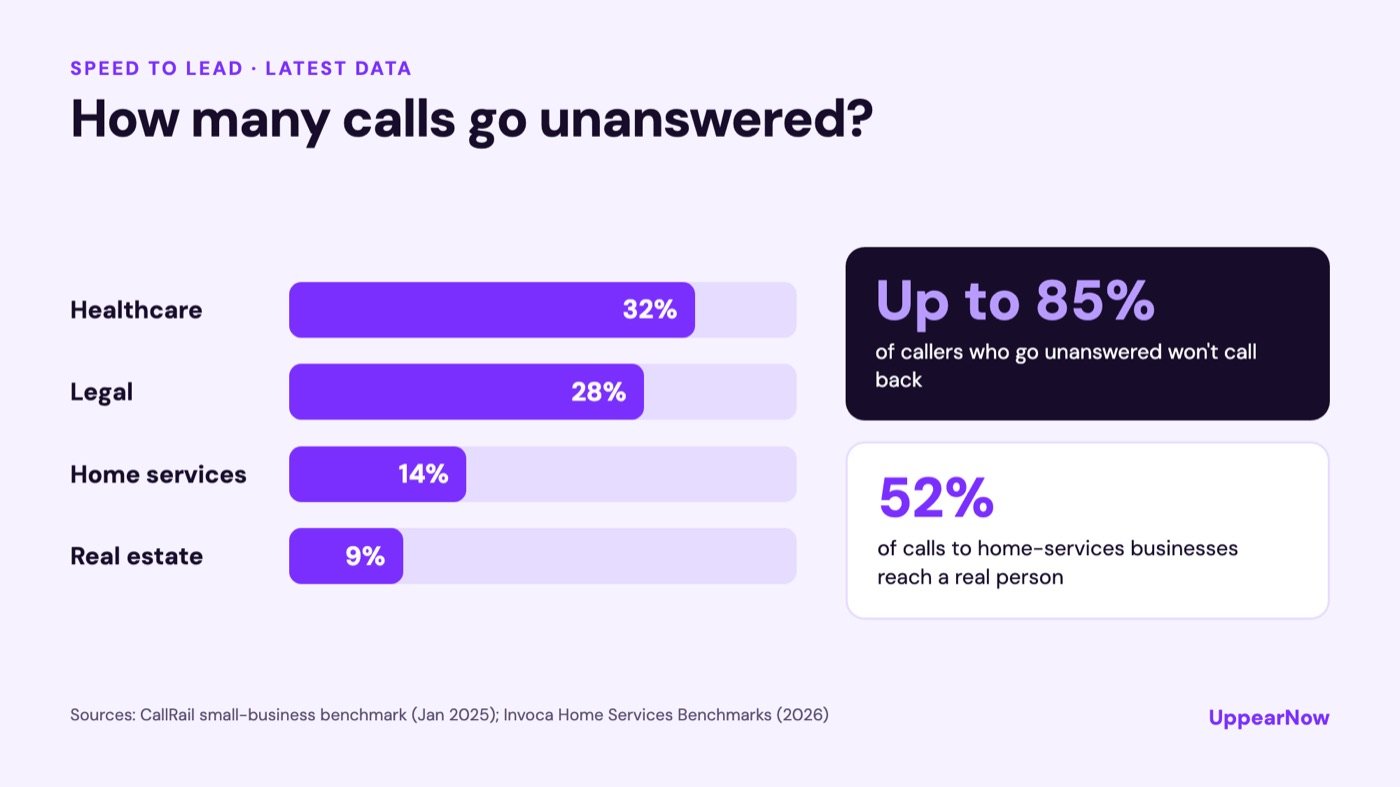
- Missed-call rates for home services (14%), healthcare (32%), legal (28%) and real estate (9%) come from the CallRail small-business benchmark report (January 2025). Other industries use an estimate. Customer values and close rates are examples, so change them to yours.
Why the first reply wins so often
A person who fills in your form at 9pm is rarely filling in only yours. They’re comparing three or four businesses, and the first one that answers clearly gets the conversation. Everyone else is competing for second place.
The research backs this up from several angles:
- Buyers favor whoever they talk to first. 6sense’s 2025 survey of nearly 4,000 B2B buyers found the vendor contacted first wins the deal about 80% of the time.
- Interest fades fast. In a Harvard Business Review analysis of 1.25 million leads, firms that tried to reach a lead within an hour were nearly 7 times as likely to qualify it as firms that waited even an hour longer.
- Missed callers don’t wait around. CallRail reports that up to 85% of people whose calls go unanswered won’t call back.
One caveat on the 6sense number: buyers often contact their favorite vendor first, so speed isn’t the only reason the first vendor wins. Even so, no study has found that replying slowly helps.
Speed to lead statistics for 2026
Many speed-to-lead articles still lean on figures from 2007 and 2011. Here is what newer data shows, with the older studies labelled so you know what you’re looking at.
| Finding | Source | Year |
|---|---|---|
| Only 52% of calls to home-services businesses reach a person (65% once calls under 15 seconds are excluded) | Invoca Home Services Benchmarks | 2026 |
| 55% of home-services businesses never ask a caller to buy or book | Invoca Home Services Benchmarks | 2026 |
| The vendor a B2B buyer contacts first wins about 80% of the time | 6sense Buyer Experience Report | 2025 |
| Missed-call rates: healthcare 32%, legal 28%, home services 14%, real estate 9% | CallRail, From Conversations to Conversions | 2025 |
| Up to 85% of callers who go unanswered won’t call back | CallRail, From Conversations to Conversions | 2025 |
| Of 2,241 US firms tested, 37% replied to an online lead within an hour; the average reply took 42 hours | Harvard Business Review | 2011 |
| Calling within 5 minutes instead of 30 made reaching a lead 100 times more likely and qualifying it 21 times more likely | InsideSales.com platform data, presented by Dr. James Oldroyd | 2007 |
Watch out: The 2007 “100x” and “21x” figures are the ones most AI answers and blog posts quote. They came from one vendor’s data across six companies and were never published in a journal. Treat them as directional, not exact.
What is a good speed to lead?
There’s no single standard, but the benchmarks line up like this:
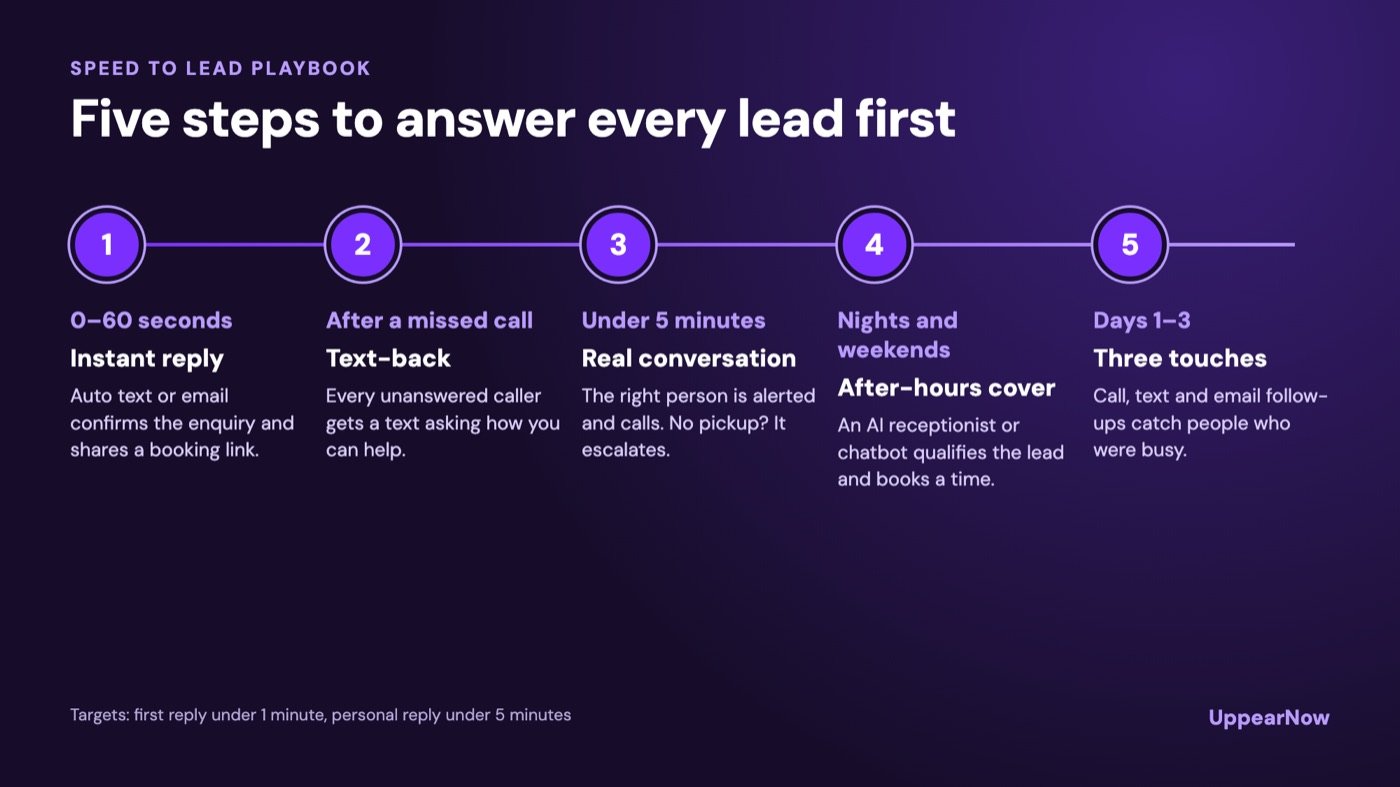
- Under 1 minute: an automated first reply (text or email) confirming you got the enquiry and saying what happens next. Software can do this every time, day or night.
- Under 5 minutes: a real conversation started, by phone or a personal message. This is the target most sales teams aim for.
- Within 1 hour: still better than most competitors. In HBR’s test, nearly two-thirds of firms took longer than this.
- Same day or later: by now, the lead has usually spoken to someone else.
Phone calls follow a stricter rule: the target is answering live. A missed call that gets a text back within seconds recovers some of those callers. A voicemail checked the next morning recovers very few.
How to measure your speed to lead
You can’t improve a number you don’t track. Measure it like this for two weeks before changing anything:
- Log the time each lead arrives. Most form tools, CRMs and call-tracking systems record this automatically.
- Log the time of the first useful reply. An auto-responder counts for the under-1-minute target. For the under-5-minute target, only a personal call or message counts.
- Work out the median, not the average. One lead answered three days late will drag an average up and hide how you usually perform.
- Break it down by channel and time. Weekday daytime is usually fine. Evenings, weekends and lunchtimes are where most leads go cold.
- Count missed calls separately. Your phone system or call-tracking tool will show unanswered calls by hour, which tells you when you need cover.
6 ways to improve speed to lead
1. Send an instant reply to every web lead
Set your forms, chat and email to reply within seconds with a short, human-sounding message: you’ve got the enquiry, and here’s when someone will be in touch. It stops the lead from filling in the next form on Google while they wait.
2. Text back every missed call
When a call goes unanswered, an automatic text goes out straight away: “Sorry we missed you, how can we help?” Many callers reply by text when they wouldn’t leave a voicemail, which makes this one of the cheapest fixes on the list.
3. Alert the right person instantly
Send new leads straight to the person who can act on them, by text or a team chat app rather than a shared inbox nobody checks. If nobody picks the lead up within 5 minutes, pass it to someone else automatically.
4. Cover evenings and weekends
Look at when your leads arrive. If a third of them come in after 5pm, you need cover then. An AI receptionist or chatbot can answer questions, qualify the lead and book a time, so the conversation starts before your team is back.
5. Let leads book themselves
Put a booking link in every first reply. A lead who picks a time slot at 10pm has already committed, and your team starts the next morning with a booked call instead of a phone-tag problem.
6. Follow up more than once
A single reply isn’t enough when the lead doesn’t answer. A simple cadence (call, text and email over the first few days) catches people who were busy the first time. Stop after the agreed number of touches so you stay helpful, not pushy.
Tip: Fix the after-hours leads first. They wait the longest, so even a basic auto-reply at night usually recovers more than shaving a few minutes off daytime replies.
Speed-to-lead templates you can copy
Swap the [brackets] for your details. Keep every message short, specific and signed by a real name.
Instant reply to a web form (SMS)
Hi [Name], thanks for contacting [Business]. We’ve got your message about [service]. [Team member] will call you within [15 minutes / 1 hour]. Prefer to pick a time? [booking link]
Missed-call text-back
Hi, this is [Business]. Sorry we missed your call! We’re probably with a customer. What can we help you with? Reply here or book a time: [booking link]
After-hours email reply
Subject: Got your enquiry, [Name]
Hi [Name], thanks for getting in touch about [service]. Our team is offline right now, but we’ll call you at [time] tomorrow. If you’d rather choose a time that suits you, here’s our calendar: [booking link]. Talk soon, [Name], [Business]
Day 2 follow-up (no reply yet)
Hi [Name], [Team member] from [Business] here. I tried calling yesterday about your [service] enquiry. Is now still a good time to help? A quick reply with the best time to call works too.
Speed to lead by industry
Response targets are similar everywhere, but where the leads get lost differs:
| Industry | Where leads are lost | First fix |
|---|---|---|
| Home services | Calls missed while the team is on a job or after hours | Missed-call text-back and an after-hours receptionist |
| Healthcare and dental | Phone queues at opening time and lunch (32% of calls missed, per CallRail) | Overflow answering and online booking links |
| Legal | New-matter calls to busy front desks (28% missed) | Live or AI intake that captures case details |
| Real estate | Portal and website leads that wait hours for a reply | Instant replies and AI qualification around the clock |
| Professional and B2B services | Form leads sitting in a shared inbox | Instant routing with a 5-minute escalation |
Real estate has the lowest missed-call rate in CallRail’s data, yet speed counts for more there than almost anywhere. Buyers enquire with several agents in a single evening, and the first to reply usually books the viewing. Our guide to speed to lead in real estate has scripts and a full setup for agents and teams.
How AI speeds up lead response
Most speed-to-lead problems aren’t about effort. They happen because people sleep, take lunch and work on jobs where they can’t pick up the phone. AI tools handle the parts that need to happen instantly:
- AI follow-up: replies to every lead within seconds, asks the right qualifying questions, and hands warm leads to your team.
- AI receptionist: answers calls when nobody can, books appointments and sends a summary.
- AI chatbot: captures website visitors at any hour and books them in. See what an AI chatbot costs for typical pricing.
None of this replaces your team. It makes sure your team spends its time talking to people who are ready to buy. For setup steps and the rules on AI calls and texts, read our guide to AI speed to lead.
Losing leads to slow replies? UppearNow sets up instant lead follow-up, missed-call text-back and AI answering for small businesses, usually within a couple of weeks.
Book a free growth reviewWant to see how it works first? Read about our AI lead follow-up service or our guide to AI marketing automation for small business.
Frequently asked questions
What does speed to lead mean?
Speed to lead is how long it takes your business to respond after a potential customer gets in touch. The clock starts when they call, submit a form, start a chat or send an email, and stops at your first useful reply.
What is a good speed to lead?
Under 5 minutes for a personal reply, and under 1 minute for an automated first response. Most businesses are far slower: in Harvard Business Review’s test of 2,241 firms, only 37% replied within an hour.
How do I calculate what slow replies cost me?
Multiply the leads you miss or reply to late by how often leads become customers, then by the average value of a customer. The calculator at the top of this page does this for you, with industry benchmarks filled in.
What is the 3-3-3 rule in sales?
There’s no single official version. The most common use is a follow-up cadence: three attempts, across three channels (call, text, email), over about three days, before deciding whether to keep pursuing a lead. It works well alongside a fast first reply.
Does speed to lead apply to phone calls?
Yes. A missed call is the slowest response of all, because many callers never try again. CallRail reports that up to 85% of people whose calls go unanswered won’t call back, so missed calls belong in your speed-to-lead numbers.
Can AI handle speed to lead?
AI can send the first reply, answer common questions, qualify the lead and book a time, all within seconds and at any hour. A person should still take over the real sales conversation. That mix gives you instant replies without making customers feel they’re talking to a machine.