By the UppearNow Team | Reviewed by Kenny Hart, Sr SEO Consultant | Last updated: October 2026
Speed to lead in real estate is how quickly an agent or team responds after a buyer or seller enquires, whether that’s a portal lead, a website form, a call from a yard sign or an open-house sign-in. Aim for a first reply within 60 seconds and a real conversation within 5 minutes. In real estate, the agent who replies first usually gets the showing.
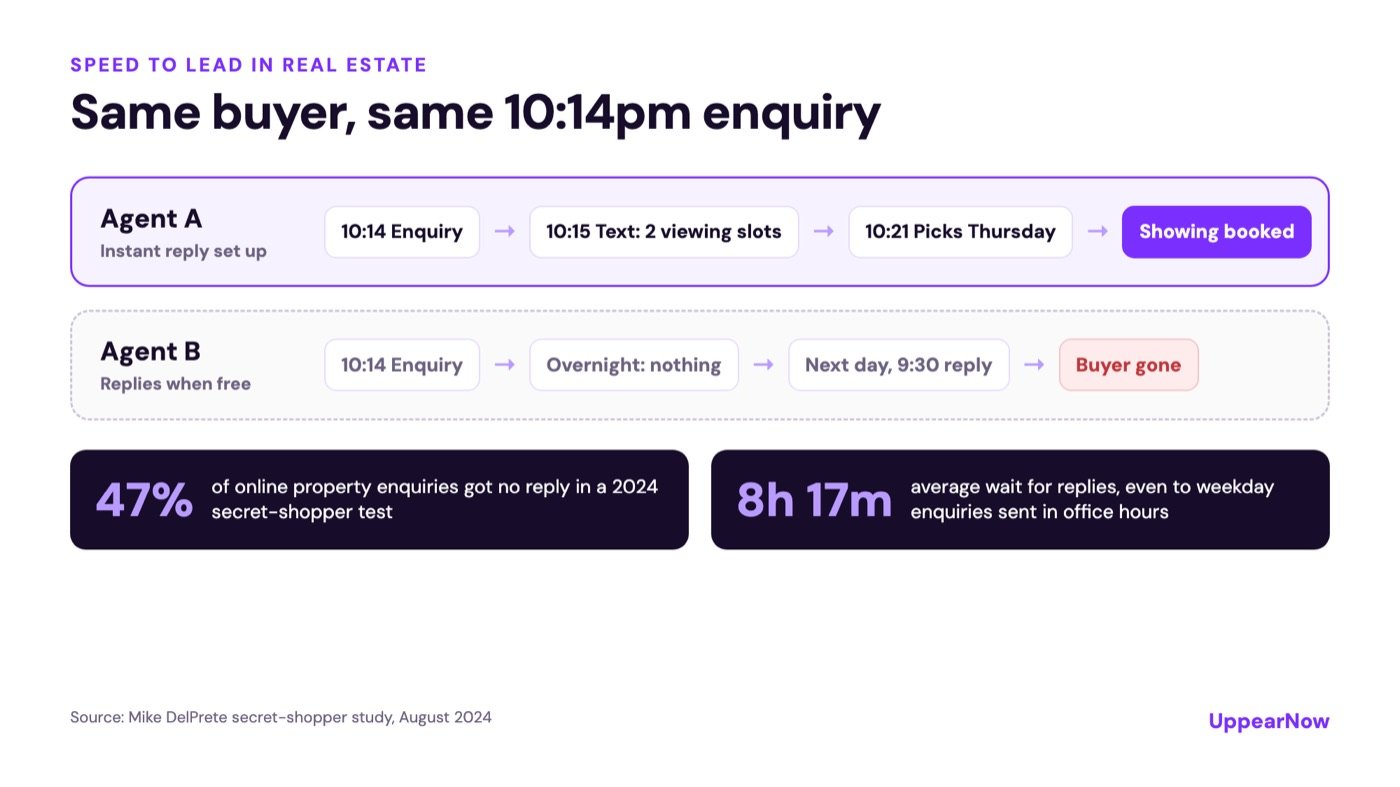
It’s 10:14pm on a Tuesday. A couple has just found a three-bed they love, and they send an enquiry to the listing agent’s website and to two others on a portal. One agent texts back within a minute with two viewing slots for Thursday. The other two reply the next morning, polite and professional, and lose the buyers before they’ve said hello.
Those few hours are where most agents lose business, and it’s surprisingly common. Mike DelPrete’s 2024 secret-shopper study found that 47% of online property enquiries got no reply at all, even though every enquiry was sent on a weekday during business hours.
See what slow replies could be costing your business. The calculator below is pre-set for real estate.
You’re likely losing about
a year
a month, or roughly customers who went elsewhere.
a year of that is realistically recoverable with instant follow-up: missed-call text-back, instant replies to web leads and after-hours answering.
Get your plan to win these leads back
We’ll email you a one-page plan for , with your numbers and the 3 fixes that recover the most revenue.
Want this fixed for you?
Book a free growth reviewHow we calculate this
- Missed calls: half of unanswered callers are counted as lost. CallRail reports up to 85% of people whose calls go unanswered won’t call back, so 50% keeps the estimate conservative.
- Slow replies: compared with replying within 5 minutes, we count 20% fewer customers when you reply within an hour, 40% fewer same day and 60% fewer next day or later. Published studies show bigger drops, so these figures stay on the cautious side.
- Recoverable: we assume instant text-back wins back half of the missed-call losses and instant replies win back 80% of the slow-reply losses.
- Missed-call rates for home services (14%), healthcare (32%), legal (28%) and real estate (9%) come from the CallRail small-business benchmark report (January 2025). Other industries use an estimate. Customer values and close rates are examples, so change them to yours.
Why real estate leads cool off so fast
Buyers in the early stages aren’t loyal to anyone yet. A few things make speed more decisive in real estate than almost anywhere else:
- Buyers enquire in batches. People rarely message one agent about one home. They contact several at once and talk to whoever responds.
- Enquiries peak when offices close. Evenings and weekends are when people browse listings, which is when most agents are off the clock.
- The listing may not wait. In a competitive area, a buyer who can’t get a viewing this week moves on to the next home and the next agent.
- Replies are slow across the industry. In DelPrete’s test, the replies that did arrive took 8 hours and 17 minutes on average (the median was 39 minutes).
Even so, most buyers still want an agent. NAR’s 2025 Profile of Home Buyers and Sellers (summary via Virginia REALTORS) found 88% of buyers purchased through an agent or broker. The demand is there. The question is which agent reaches them first.
Where agents lose leads
Each lead source has its own weak spot. Find yours in the table and fix that first:
| Lead source | How it usually goes cold | What fixes it |
|---|---|---|
| Portal enquiries | Several agents get the same buyer, and the slowest reply loses | An instant text with viewing times, sent within 60 seconds |
| Website and IDX sign-ups | Saved searches sit in the CRM with no personal contact | An automatic message asking what the buyer is looking for |
| Sign and ad calls | Calls ring out while you’re showing another home | Missed-call text-back plus after-hours answering |
| Open-house visitors | Sign-in sheets are followed up days later, or never | A same-day thank-you text with similar listings |
| Seller valuation requests | A generic report arrives with no follow-up call | An instant reply, then a call booked within the hour |
| Investor and wholesaler leads | Motivated sellers call several buyers, and the first callback wins | Live answering or a callback within minutes |
A speed-to-lead system for agents and teams
Solo agents and 20-person teams follow the same order. Only the size of the setup changes.
1. Reply within 60 seconds, every time
An automatic text and email go out the moment a lead arrives. Keep them personal: the property address, your name, and a question that’s easy to answer. A buyer who replies to your first text is already halfway to a showing.
2. Qualify with three questions
You don’t need a long form. Three answers tell you who’s ready now and who’s browsing:
- Timing: when are they hoping to move?
- Financing: are they pre-approved, or would a lender introduction help?
- Must-haves: area, budget and the one feature they won’t compromise on.
3. Put a showing or call in the calendar
Offer two specific times instead of asking “when suits you?” Specific choices get faster answers. Once the slot is booked, the lead belongs to you.
4. Route leads fairly on a team
For teams, send each lead to the next available agent and set a rule: if nobody claims it within 5 minutes, it goes to the next person or the team lead. Leads shouldn’t wait because one agent is in a closing.
5. Nurture the ones who aren’t ready
Many buyers are months away from moving. Keep them warm with new listings that match their search and a personal check-in every few weeks. When they’re ready, you’re the agent they remember.
Real estate follow-up scripts
These are written for real estate leads. Change the [brackets] and keep your own voice.
Portal enquiry, first text
Hi [Name], it’s [Agent] with [Brokerage]. Thanks for asking about [address]! It’s still available. I can show it Thursday at 5:30 or Saturday at 11. Does either work?
Seller valuation request
Hi [Name], [Agent] here. Thanks for requesting a value on [address]. Online estimates can miss a lot (upgrades, views, the street itself), so I’d love to give you a real number. Could I swing by for 15 minutes this week?
Missed call from a sign
Hi, it’s [Agent]. Sorry I missed your call. I’m probably showing a home! Were you calling about [address]? Happy to answer questions here or call you back in a few minutes.
Open-house follow-up, same day
Hi [Name], thanks for stopping by [address] today! Any questions I can answer? I’ve also got two similar homes nearby that haven’t hit the portals yet. Want me to send them over?
How to measure response speed on your team
Track three numbers weekly. Most real estate CRMs report them automatically:
- Median time to first reply. Use the median, so one weekend lead answered on Monday doesn’t hide your usual pace.
- Contact rate. The share of leads you actually spoke to or exchanged messages with.
- Appointment rate. The share of leads who booked a showing, call or listing appointment.
If your contact rate is low, speed is usually the problem. If contact is high but appointments are low, look at your scripts and how you qualify.
Rules to check before you automate
Automatic texts and calls are covered by the Telephone Consumer Protection Act (TCPA) and the Do Not Call rules. Before you switch anything on:
- Get clear consent on your forms. Add a line saying the person agrees to be contacted by call and text about their enquiry.
- Honor opt-outs straight away. Every text system should stop when someone replies STOP.
- Check your brokerage’s rules and any portal terms on how leads are contacted.
- Be careful with AI voice calls. Since February 2024, AI-generated voices on calls have needed the same consent as recorded messages. Our guide to AI speed to lead covers the rules in more detail.
This is general information, not legal advice. Check with your broker or attorney if you’re unsure.
Missing buyers after hours? UppearNow sets up instant lead replies, AI qualification and showing booking for agents and teams.
Book a free growth reviewFor response benchmarks across every industry, see our speed to lead guide, or read how our AI lead follow-up works.
Frequently asked questions
What is speed to lead in real estate?
It’s the time between a buyer or seller enquiring and an agent’s first useful reply. That covers portal enquiries, website forms, calls from signs and ads, and open-house sign-ins.
How fast should a real estate agent respond to a lead?
Send an automatic first reply within 60 seconds and have a real conversation within 5 minutes. In DelPrete’s 2024 test, the average agent reply took over 8 hours, so even a one-hour response beats many competitors.
Why do so many real estate leads go unanswered?
Agents spend much of the day showing homes, in negotiations or at closings, and many leads arrive in the evening. Without automation, enquiries wait until the agent is free. DelPrete found 47% of online enquiries got no reply at all.
Should real estate agents use AI to respond to leads?
AI works well for the first reply, basic questions, qualifying and booking showings at any hour. Pricing advice, negotiation and anything sensitive should stay with the agent. Most teams use AI to start the conversation and agents to build the relationship.
Does speed to lead work for seller leads too?
Yes. Sellers requesting a valuation are often speaking to several agents. A quick, personal reply and an offer to visit stands out against an automated report that arrives with no follow-up.